
Saturday, May 26, 2007

Friday, May 18, 2007
Goodbye AOL; Hello Google!
Today is my last day at AOL. I celebrated my binary millennial in February, and it's time to move on... to some exciting new things over at Google. I'm going to continue to work in the community/social networking area and I plan to keep gently evangelizing user centric identity, REST, Atom, and feed technologies, among many other things. And, yes, getting products out the door too. It'll be fun.
I don't know yet if I'll continue using this blog; but regardless, http://abstractioneer.org will always resolve to where I'm blogging (anything can be solved with one level of indirection). And =john.panzer will always reach me.
I don't know yet if I'll continue using this blog; but regardless, http://abstractioneer.org will always resolve to where I'm blogging (anything can be solved with one level of indirection). And =john.panzer will always reach me.
Wednesday, May 16, 2007

New Journals features: Video, pictures, mobile... and Atom!
The team just added some cool features to Journals last night. There's a new button that lets you easily add pictures from various Flickr, your computer, AOL Pictures, or an arbitrary URL. There's a video button that lets you upload a video to embed in your entry or About Me, or record directly from your webcam. The latter uses the Userplane video recorder widget, which was a breeze to integrate with. We're also highlighting our mobile posting feature at http://journals.aol.com, which lets you post via your cell phone (or email!) including pictures or video. Here's a quick trick: You can use this feature to integrate iPhoto with your blog; just choose to Share via email and put in your blog's email address.
We've also made some changes to our Atom API to bring it more into line with the draft APP standard; it's not 100% there yet but it's close and certainly usable.
We've also made some changes to our Atom API to bring it more into line with the draft APP standard; it's not 100% there yet but it's close and certainly usable.
Tuesday, May 15, 2007
At iiw2007a: Concordia (Eve Maler)
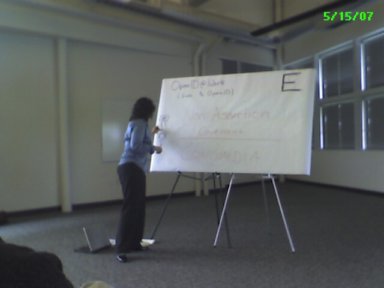
Eve draws up a diagram showing how 'bootstrapping' works in SAML/Liberty WS. Discussion ensues with many queries about Condordia. More questions than answers, but I think that people have a lot of related/interlocking problems that need solving.
Starting from OpenID, it sounds to me like all these cases are a subset of the "access a service on behalf of a user" use case; hopefully solving either one will help with the other.Monday, May 14, 2007
At IIW2007
I'm at IIW right now and also hacking away on OpenAuth and Blogs. Which does make sense since the people I need to talk to about how it should work are mostly here, with the exception of Praveen, who for some inexplicable reason prefers France.
So far so good; this curl command posts a blog entry on my Atom blog service:
curl -k -v -sS --include --location-trusted --request POST --url 'https://monotreme:4279/_atom/collection/blogssmoketester' --data @/tmp/ieRN0zhgh6 --header 'Content-Type: application/atom+xml; charset=utf-8' --header 'Authorization: OpenAuth token="%2FwEAAAAABYgbMtk4J7Zwqd8WHKjNF6fgJSYe4RhTuitkNyip%2BEru%2FY43vaGyE2fTlxKPAEkBC%2Bf5lhWg18CE2gaQtTVQy0rpillqtUVOOtrf1%2BLzE%2BNTcBuFJuLssU%2B6sc0%3D" devid="co1dDRMvlgZJXvWK"'
Note that the token, which gives authorization and authentication, is obtained with a separate login call to an internal OpenAuth server. It looks like I need both the token and the devid; the devid essentially identifies the agent representing the user.
I should be able to post this curl command line with impunity because it shouldn't expose any private data, unlike the HTTP Basic Auth equivalent which exposes the user's password in nearly clear text. This also implies that it should be possible to avoid using TLS.
Now, if I had a standard way to get a token for an OpenID session, I could pass that in like so:
Authorization: OpenID token="...."
And my server will advertise that it accepts all three -- Basic, OpenAuth, and OpenID. I hope to talk with like minded people about this at IIW.
So far so good; this curl command posts a blog entry on my Atom blog service:
curl -k -v -sS --include --location-trusted --request POST --url 'https://monotreme:4279/_atom/collection/blogssmoketester' --data @/tmp/ieRN0zhgh6 --header 'Content-Type: application/atom+xml; charset=utf-8' --header 'Authorization: OpenAuth token="%2FwEAAAAABYgbMtk4J7Zwqd8WHKjNF6fgJSYe4RhTuitkNyip%2BEru%2FY43vaGyE2fTlxKPAEkBC%2Bf5lhWg18CE2gaQtTVQy0rpillqtUVOOtrf1%2BLzE%2BNTcBuFJuLssU%2B6sc0%3D" devid="co1dDRMvlgZJXvWK"'
Note that the token, which gives authorization and authentication, is obtained with a separate login call to an internal OpenAuth server. It looks like I need both the token and the devid; the devid essentially identifies the agent representing the user.
I should be able to post this curl command line with impunity because it shouldn't expose any private data, unlike the HTTP Basic Auth equivalent which exposes the user's password in nearly clear text. This also implies that it should be possible to avoid using TLS.
Now, if I had a standard way to get a token for an OpenID session, I could pass that in like so:
Authorization: OpenID token="...."
And my server will advertise that it accepts all three -- Basic, OpenAuth, and OpenID. I hope to talk with like minded people about this at IIW.
Monday, May 7, 2007
Sun += OpenID
Tim Bray just blogged
about openid.sun.com, which is an identity provider for Sun
employees only. Interesting! Though technically one would like to be
able to do independent assertions about user centric identities ("works
for Sun" being a reasonable assertion one could make about any
identity). I suppose though that someone could use OP delegation to
point http://me.example.org to openid.sun.com and achieve part of the
same effect. And in the end you'll need to rely on something like
openid.sun.com to validate assertions presumably.
Subscribe to:
Posts (Atom)
